
The Plan Before the Mountain: How Nutrition Shapes Sheep Hunting Success
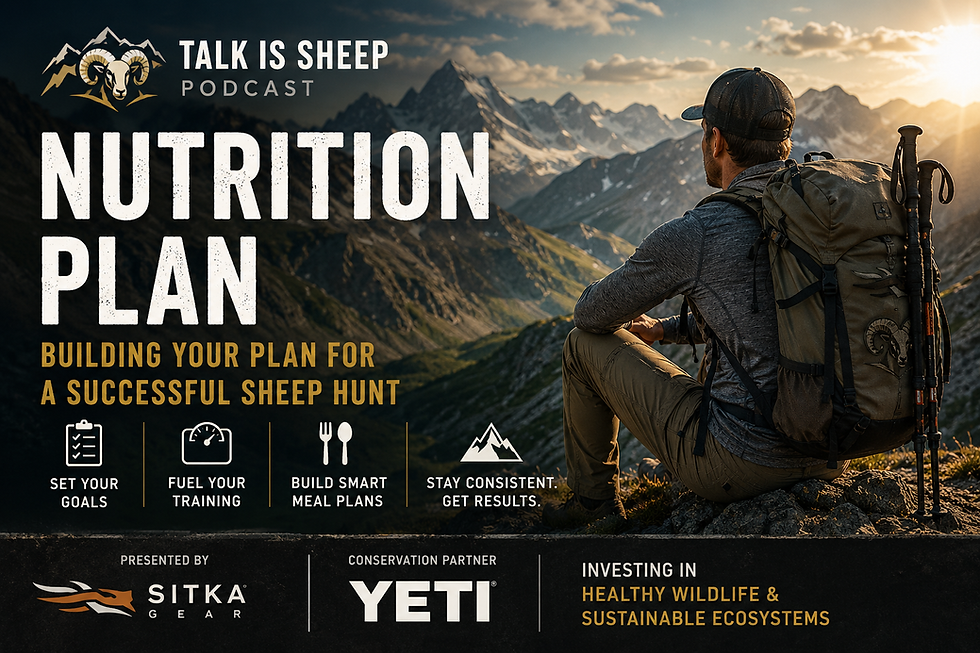
There’s something special about sheep hunters.
If you’ve ever walked into Sheep Week—whether in Reno, Idaho, or British Columbia—you’ve felt it. The camaraderie. The passion. The stories traded in hallways between old friends and first-time attendees. It’s a community built on grit, conservation, and a shared respect for wild places.
And increasingly, it’s a community embracing a truth that more hunters are beginning to understand:
Success in the mountains starts long before opening day.
Training matters. Gear matters. But nutrition is often the overlooked piece that ties it all together.
In a recent conversation with Kyle Stelter of Wild Sheep Society of BC, we dug into what it actually looks like to prepare your body for a sheep hunt—and how to build a nutrition plan that supports both performance and longevity.
Start With the End in Mind
Five months out from a hunt is where the real preparation begins.
Before calories, macros, or meal prep containers, I recommend starting with one simple question:
What do you want to feel like when August arrives?
For most hunters, the answer falls into one of three categories:
Lose body fat
Improve performance
Or both
That answer becomes your target.
Without it, nutrition becomes guesswork.
I compare it to sighting in a rifle without a target downrange—you can pull the trigger all day, but without something to aim at, you’ll never know if you’re hitting what you want.
You Can’t Outrun Your Nutrition
Many hunters go all-in on training programs this time of year. More hikes. More weight. More suffering.
But there’s a limit to what training can do if nutrition isn’t supporting it.
As I said in the poddcast:
“The nutrition is designed to allow you to execute your training program—and recover from it.”
If the body doesn’t have fuel, it can’t perform.
And if it can’t recover, it can’t adapt.
That’s where many hunters get stuck. They slash calories too aggressively trying to lose weight, only to find themselves exhausted halfway through the week with no energy left for training.
The goal isn’t to starve your way into sheep shape.
The goal is to create just enough deficit to move body fat while still having enough fuel to train hard and recover well.
Why Carbs Still Matter
One of the biggest misconceptions Kyle sees is the idea that carbs are the enemy.
Hunters often assume that cutting carbs equals faster fat loss.
But it’s rarely that simple.
Carbohydrates are your body’s preferred fuel source during hard efforts—steep climbs, heavy pack-outs, interval work, and long training sessions.
Cut them too low, and performance usually suffers first.
The result?
You may lose some weight… but your training quality drops, your recovery worsens, and by Friday you feel worse than you did Monday.
Instead, a balanced approach works better:
Carbohydrates for training energy
Protein for recovery and muscle repair
Fat for overall health and hormone support
All three matter.
Build a Plan You Can Actually Live With
One of the most practical takeaways from the conversation was this:
The best nutrition plan is the one you can actually repeat consistently.
That means it has to work inside your life.
Inside your work schedule.Inside your family dinners.Inside road trips, weekends, birthdays, and summer barbecues.
Not every hunter wants—or needs—to eat chicken and rice out of a Tupperware container seven days a week.
For some, meal prep works great.
For others, flexibility is the difference between sticking with a plan and quitting after two weeks.
I recommend thinking in simple daily budgets.
For example:
If your target is 2,000 calories and you like eating four times per day, aim for roughly 500 calories per meal.
That framework gives structure without rigidity.
It prevents blowing through your calorie intake by 10 a.m.—and leaves room for real life later in the day.
Consistency Wins More Than Perfection
The biggest mistake hunters make?
It isn’t carbs.It isn’t protein.It isn’t supplements.
It’s inconsistency.
Here's what we see constantly:
“Perfect” during the week. Off the rails on the weekend.Repeat Monday.
Those weekends can quietly undo all the progress from Monday through Friday.
Instead of chasing perfection, focus on stacking consistent days.
Good days repeated over months matter far more than extreme effort repeated for a few days.
The mountain doesn’t reward perfection.
It rewards consistency.
Don’t Let the Scale Be the Only Judge
Another trap many hunters fall into is obsessing over body weight.
The scale can be helpful—but it’s incomplete.
You can lose inches while body weight stays flat.You can gain muscle while losing body fat.You can get stronger while the number goes up.
That doesn’t mean the plan isn’t working.
Track progress through multiple lenses:
How your clothes fit
Waist or hip measurements
Progress photos
Workout performance
Energy levels
Recovery
Sleep quality
The scale is one data point—not the whole story.
Mental Discipline Is Built Daily
One of the strongest parallels between sheep hunting and nutrition came near the end of the conversation.
Mental discipline isn’t built in the mountains.
It’s built before them.
Every workout you show up for when you don’t feel like going.Every early alarm. Every food choice aligned with your goal instead of the easier option.
Those moments matter.
That discipline compounds.
And by the time season arrives, it becomes second nature.
That’s what carries you through bad weather, heavy packs, missed opportunities, and long days above timberline.
Final Thoughts: The Plan Before the Hunt
Five months from now, the mountains won’t care how motivated you felt in March.
They’ll care how prepared you became between now and then.
So start simple:
Decide what outcome you want
Build a realistic nutrition plan
Support your training with enough fuel
Stay consistent longer than feels exciting
Adjust when needed—but don’t quit too early
And remember:
You don’t need perfect.
You need repeatable.
Because sheep shape isn’t built in a single workout, a crash diet, or a weekend of motivation.
It’s built meal by meal.Workout by workout.Day after day.
Long before the mountain ever begins.
Want help building your nutrition plan for the season ahead? Learn more at Valley to Peak Nutrition or apply here.


![Four Things For All Day Fueling On the Trail to Push Limits [AND BEYOND]](https://static.wixstatic.com/media/86c542_15223e1d702c4e99a820206a997e949b~mv2.png/v1/fill/w_1762,h_1000,fp_0.50_0.50,q_35,blur_30,enc_avif,quality_auto/86c542_15223e1d702c4e99a820206a997e949b~mv2.png)
![Four Things For All Day Fueling On the Trail to Push Limits [AND BEYOND]](https://static.wixstatic.com/media/86c542_15223e1d702c4e99a820206a997e949b~mv2.png/v1/fill/w_296,h_168,fp_0.50_0.50,q_95,enc_avif,quality_auto/86c542_15223e1d702c4e99a820206a997e949b~mv2.png)


Comments