
Episode 118: The origins and future of backpacking food with Greenbelly Meals Founder, Chris Cage.
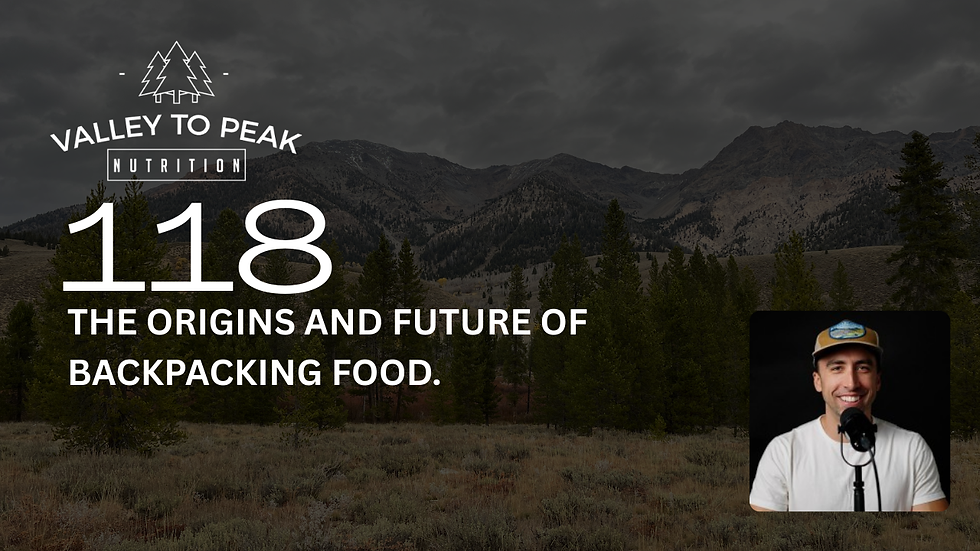
You can checkout the entire episode about the origins and future of backpacking food with Greenbelly Meals Founder, Chris Cage here:
From Trail Miles to Meal Bars: The Story Behind Green Belly Meals. Featuring Chris Cage, Founder of Green Belly Meals.
Most people in the outdoor world know Green Belly Meals. The brand’s Meal To-Go bars have become a staple for backpackers, thru-hikers, and backcountry hunters who need serious calories in a compact, no-nonsense format. What fewer people know is the story behind the product—and the philosophy that continues to shape it.
In this episode of the Valley to Peak Nutrition Podcast, I sat down with Chris Cage, founder of Green Belly Meals, to talk about how a former accountant turned six months on the Appalachian Trail into a decade-long journey building one of the most respected brands in backpacking nutrition.
What followed was a conversation about exploration, product development, resisting trends, and why sometimes the best growth strategy is simply to make better products and better content that's also helpful for people.
Leaving the Spreadsheet for the Trail
Chris graduated college in 2010 and did what many people do: he took a stable job in accounting. Two years in, he realized something wasn’t quite right—not because accounting was awful, but because there was something else pulling at him- a pull that had been there for years.
As a Boy Scout in North Georgia, Chris first learned about the Appalachian Trail and was struck by the idea that a single path stretched thousands of miles all the way to Maine. Later, stories of people hitchhiking, meeting strangers, and disappearing into the woods for months at a time only added to the intrigue.
Chris quit his job and set out on an ambitious adventure:
A six-month thru-hike of the Appalachian Trail
A three-month bicycle tour of New Zealand
Extended travel throughout Asia, including teaching English and volunteering
It wasn’t about running away from a bad job. It was about gravitating toward something bigger—exploration, discomfort, and experience.
The Problem Every Thru-Hiker Knows Too Well
Six months on the Appalachian Trail will teach you many things. One of them is how brutally difficult it is to eat enough.
Chris quickly noticed that nearly every bar on the market was essentially a snack pretending to be a meal. Two hundred calories here, maybe three hundred there—fine for an afternoon hike, but laughably insufficient for someone burning thousands of calories per day.
Hikers compensated however they could:
Spoonfuls of peanut butter
Olive oil added to meals
Constant grazing just to keep energy levels up
What Chris wanted didn’t exist: a true, high-calorie, ready-to-eat meal in bar form.
That insight became the foundation for Green Belly.
From Kitchen Experiments to Food Science
Like many founder stories, Green Belly didn’t start in a factory—it started in a kitchen.
Chris’s first iteration wasn’t even a bar. It was more like a calorie-dense “goo,” a peanut-butter-and-oats mixture meant to be eaten by the spoonful. It solved the calorie problem, but not the practicality problem.
From there came the hard part: turning an idea into something shelf-stable, durable, and consistent across temperatures and conditions.
Chris eventually invested most of his savings into working with a food scientist, dialing in macro targets, ingredient profiles, and structure. Early samples were handed out at events like Trail Days in Damascus, Virginia, where real hikers gave brutally honest feedback. Iteration after iteration followed—refined not just by spreadsheets, but by trail-tested reality.
Scaling Without Losing the Soul
Green Belly’s growth didn’t come from flashy ads or influencer campaigns. It came from something far less common: education.
Chris began writing in-depth articles about hiking, nutrition, and outdoor life—initially as a way to document his own experiences. Over time, those articles began driving serious traffic through search engines, becoming one of the brand’s biggest growth engines.
That same philosophy later extended to video.
Today, Green Belly’s YouTube channel features well-produced content on topics like:
What hiking does to the body
The nutritional realities of trail food
Documentary-style storytelling (Made of Grit)
Gear breakdowns and long-form interviews
Notably absent? Hard product pitches. Something very refreshing in the current social media carosel of promotion.
The approach mirrors brands like Red Bull—build association through value, storytelling, and authenticity rather than constant selling.
Nutrition Philosophy: Substance Over Trends
One of the most compelling parts of the conversation was Chris’s resistance to nutrition fads.
Green Belly originally positioned its bars as delivering roughly one-third of daily nutrition needs, but over time, Chris intentionally softened those claims. Nutrition guidelines change. Context matters. Over-promising doesn’t age well.
Instead, the focus became simpler and stronger:
High calories
Balanced macros
Sufficient protein, fat, carbs, fiber, and sodium
Food designed for people doing hard things
That philosophy recently led to the development of a high-protein Meal To-Go, offering roughly 40 grams of protein with significantly less sugar—an option for athletes and outdoor users whose needs differ from traditional thru-hikers.
Growth, But Not at Any Cost
When asked where he sees Green Belly in 5–10 years, Chris’s answer was refreshingly grounded.
Not world domination.Not hyper-scaling.Not chasing every trend.
Instead:
Better products
Cleaner ingredients
More consistency
Higher-quality videos
Deeper mastery of storytelling
Even today, many Green Belly bars are still hand-formed in small batches—a conscious decision to protect quality over convenience.
It’s a reminder that growth without intention can hollow out what made something special in the first place.
Trail Wisdom, Gear Regrets, and Pork Rinds
The conversation also covered lighter ground:
Underrated trail foods: pork rinds (for crunch and durability) and seaweed (a rare shelf-stable vegetable)
Best gear innovation: squeeze water filters like Sawyer—simple, affordable, and transformative
Worst gear mistakes: outdated hiking footwear before trail runners became mainstream
Best advice for thru-hikers: know why you’re doing it—because there will be days when everything is wet, cold, lonely, and miserable
As Chris put it, the people who finish aren’t always the strongest—they’re the ones who understand their reason for starting.
Why This Story Matters
Chris Cage’s journey isn’t just about meal bars. It’s about what happens when experience, curiosity, and restraint intersect.
Green Belly exists because someone lived the problem first.It grew because education mattered more than hype.And it continues because the founder values quality, storytelling, and intention over constant expansion.
For anyone building something—whether a product, a career, or a life path—the lesson is clear:
Do the thing deeply.Iterate honestly.And don’t let “more” come at the expense of “better.”
You can find Green Belly Meals at greenbelly.co, explore their educational content on YouTube, or reach Chris directly at chris@greenbellybar.com.


![Four Things For All Day Fueling On the Trail to Push Limits [AND BEYOND]](https://static.wixstatic.com/media/86c542_15223e1d702c4e99a820206a997e949b~mv2.png/v1/fill/w_1762,h_1000,fp_0.50_0.50,q_35,blur_30,enc_avif,quality_auto/86c542_15223e1d702c4e99a820206a997e949b~mv2.png)
![Four Things For All Day Fueling On the Trail to Push Limits [AND BEYOND]](https://static.wixstatic.com/media/86c542_15223e1d702c4e99a820206a997e949b~mv2.png/v1/fill/w_296,h_168,fp_0.50_0.50,q_95,enc_avif,quality_auto/86c542_15223e1d702c4e99a820206a997e949b~mv2.png)


Comments